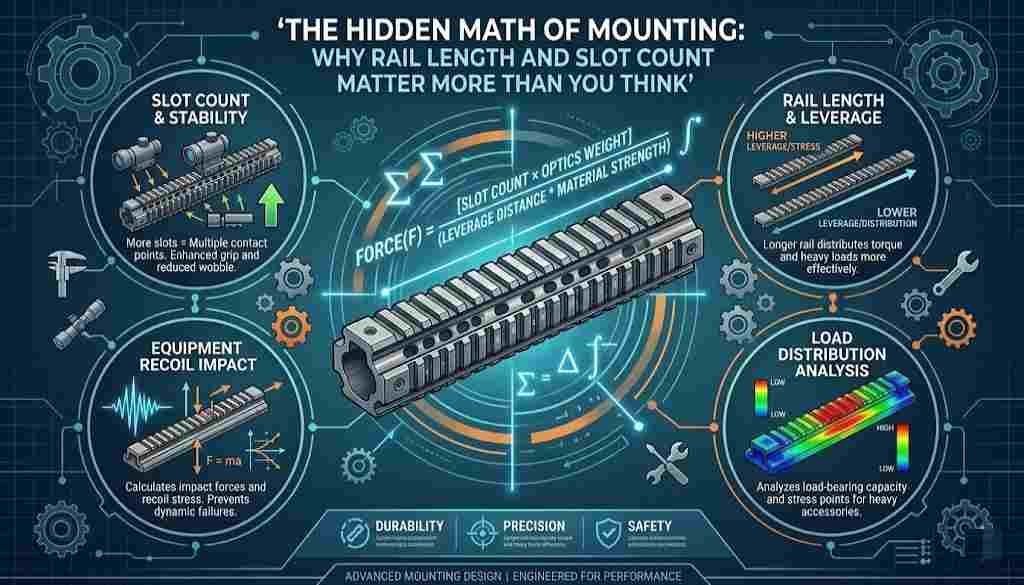
Most shooters spend their time comparing optics, ammunition, and accessories, but few stop to consider the basic geometry of the rail underneath their scope. Yet the dimensions of that rail, including its length and the number of slots it offers, can quietly determine how flexible, accurate, and adaptable the entire setup turns out to be. The math is hidden, but it shapes nearly every shooting outcome that follows.
When evaluating a picatinny rail for mini 14, shooters often focus on appearance or brand reputation. Those factors matter, but the practical performance of the rail comes down to dimensions and design. Length affects optic positioning. Slot count affects mounting flexibility. Together, they determine how well the rail serves the rifle and the shooter.
- What Rail Length Actually Affects
- Optic Eye Relief
- Multi-Optic Compatibility
- Future-Proofing the Setup
- Why Slot Count Is Just as Important
- Positioning Resolution
- Mount Engagement
- Standard Compliance
- How Length and Slot Count Work Together
- Common Geometry Mistakes That Cost Performance
- Why This Math Matters More on Some Rifles
- Practical Buying Considerations
- Measure Your Optic Plan
- Verify Slot Count
- Check Fit With Your Rifle
- Final Thoughts
What Rail Length Actually Affects
Rail length is not just a style choice. It directly impacts the range of optics you can use, the eye relief positions you can achieve, and the overall balance of the rifle. A rail that is too short forces compromises. A rail with appropriate length opens up more setup possibilities.
Optic Eye Relief
Every optic has a recommended eye relief, which is the distance between the shooter’s eye and the rear lens that produces a clean sight picture. If the rail is too short, the optic may not be able to slide into the position where eye relief is correct. That forces awkward shoulder posture or compromises the sight picture entirely.
Multi-Optic Compatibility
A longer rail makes it possible to mount more than one optic-related accessory. For example, a magnifier can sit behind a red dot, or a backup iron sight can ride alongside a primary scope. Without enough rail real estate, those layered setups become impossible, even when the optics themselves are compatible.
Future-Proofing the Setup
Shooters often start with one optic and switch to another over time. A rail with reasonable length lets you adapt to those changes without replacing the rail itself. That flexibility saves money and reduces the hassle of redoing the entire mounting setup.
Why Slot Count Is Just as Important
Slots are the cross-cut grooves along the top of a Picatinny rail. Each slot serves as a potential mounting point. The number of slots, and the consistency of their spacing, affects how precisely the optic can be positioned and how secure the mounting connection actually is.
Positioning Resolution
More slots mean more available positions for the mount. With fewer slots, the shooter has limited choices for where to lock down the optic. That can force compromises in eye relief or balance that would not be necessary on a rail with finer positioning options.
Mount Engagement
Most quality optic mounts engage with multiple slots simultaneously to spread out the mounting force. A rail with too few slots may not allow the mount to use all of its contact points. That can reduce holding strength under recoil and make the system more vulnerable to shifting over time.
Standard Compliance
Picatinny rails are based on a military standard, which means slot spacing and dimensions are supposed to be consistent. A rail with proper slot count and accurate machining works seamlessly with any standard mount. A rail with inconsistent spacing creates compatibility issues that may only show up when you try to switch optics or accessories.
How Length and Slot Count Work Together
These two dimensions are not independent. They interact in ways that determine the practical capability of the rail. A long rail with too few slots is mostly wasted space. A short rail with dense slot count limits flexibility because there simply is not enough rail to take advantage of the resolution.
The right balance is a rail that offers enough length to support modern optic positioning and enough slots to lock the mount down precisely. That combination is what allows the shooter to set the rifle up properly without fighting against the geometry.
Common Geometry Mistakes That Cost Performance
Many shooters end up with mounting frustrations that trace back to a poor rail choice. Recognizing the common mistakes makes it easier to avoid them.
- Choosing a rail without confirming it has enough length for the intended optic
- Overlooking slot count when planning to use multiple accessories
- Assuming all rails labeled Picatinny are dimensionally identical
- Ignoring how rail length affects the rifle’s overall balance
- Forgetting to consider future optic changes when picking the initial rail
Why This Math Matters More on Some Rifles
Certain rifle platforms have factory designs that complicate optic mounting. The Mini-14 is one of those platforms. Its receiver geometry, sight system, and gas operation create specific challenges that generic rails cannot always solve. That is why rail dimensions matter even more on this rifle than they do on platforms that were designed around modern optics from the start.
A purpose-built rail accounts for these challenges. It is sized and slotted to fit the rifle without compromising clearance, balance, or functionality. Generic rails sometimes work, but they often introduce small problems that compound during real shooting use.
Practical Buying Considerations
When shopping for a rail, the temptation is to compare prices first. That is understandable, but it leads to disappointing outcomes more often than not. A better approach is to evaluate the dimensions and design first, then check whether the price reflects what the rail actually offers.
Measure Your Optic Plan
Before buying, think about what optic you want to run, including any backup or layered setups. Then check whether the rail has enough length to support that plan with proper eye relief.
Verify Slot Count
Look at the number of slots and confirm they are spaced according to standard dimensions. Photos and product listings sometimes obscure this detail, but it is worth confirming before purchase.
Check Fit With Your Rifle
A rail purpose-built for the Mini-14 is a different product than a generic rail trimmed to length. The difference shows up in how the rail mates with the receiver and how stable the mounting becomes over time.
Final Thoughts
The hidden math of mounting is not glamorous, but it shapes every aspect of how a rifle performs once an optic goes on top of it. Rail length determines what optics you can run and how comfortably the rifle shoulders. Slot count determines mounting precision and security. Together, they decide whether the setup is going to feel solid or compromised every time you take the rifle to the range.
Choosing the right picatinny rail for mini 14 is a decision that pays off across the entire life of the rifle. It supports better optic positioning, more reliable zero retention, and the flexibility to adapt as your shooting goals evolve. Spend a little time on the math, and the rifle that follows will reward you with consistency that cheaper choices simply cannot deliver.